Monday, September 22, 2008

The Chinese Memory-Part 2

The Chinese Memory
Exhibition at the Capital Museum, China
July 29 – October 7, 2008
Beijing, China
http://www.capitalmuseum.org.cn/exhibitionpage/zgjy.htm
Translated and edited by Staff of Orilily LLC


Part 2 –Govern the Country with Ritual Music (BC2000-BC200)

With the development of statehood, Chinese civilization reached its first booming period, symbolized by the sophisticated bronze ware and the ritual music that were mainly used for governing the states.

Xia Dynasty (BC2000 – BC1500) , Shang Dynasty (BC1500-BC1000), and Zhou (BC1000-BC221) are the three states before Qin Dynasty (BC221-BC207) which consolidated the small states into one, and started the Chinese order and normalcy that lasted for the following 2000 more years.

Xia Dynasty was established by Xia Yu in the area that is in today's He Nan province. Chinese scholars considered this area as the central region (Zhong Yuan) for that time.


The exquisite bronze ware were mainly used for sacrifice rites, they carry the message of the stately and overly elaborate rites to us


The booming development of bronze ware in the central region radiated to the neighbouring regions, leading to the thriving civilization of those regions with their own character and charm

Warrior and war related articles from Qin

Qin is a small state to the west. After a fast development period, it became very powerful and consolidated the other six states, leading to the establishment of the Qin Dynasty, which was widely regarded as the beginning of the Middle Kingdom. Qin Dynasty standardized the measuring system and characters, integrated the local civilizations, and set a profound foundation for the Chinese civilization that we know today.

Sun God Bird in Gold (BC1300-BC1046)
It has been adopted as the symbol of Chinese Culture Heritage since Aug.16, 2005


Wine pot carried by two naked men (BC1046-BC771)


Bronze axe with human face (~BC1300-BC1046)


Bronze carriage with human figures
without foot/feet from punishment (BC1046-BC771)
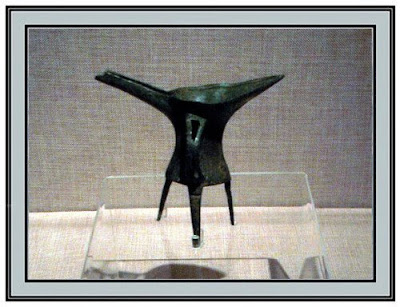


The earliest bronze wine cup (~BC2070-BC1600)


Bronze drum carrier with dragon and tiger sculptures (BC770-BC476)
Drum was used for war, sacrifice rites, etc. at the time


Wine kettle (BC770-BC476)


Flying dragon and dancing phoenix jade ornament (BC475-BC221)


Lacquer container with snake as foot and a phoenix in the middle carrying the plate
beautiful and vivid inlays of dragon, phoenix, snake and turtle (BC475-BC221)

Sunday, September 21, 2008

The Chinese Memory-Part 1

The Chinese Memory Exhibition at the Capital Museum, China
July 29 – October 7, 2008 Beijing, China http://www.capitalmuseum.org.cn/exhibitionpage/zgjy.htm
Translated and edited by Staff of Orilily LLC

First Light of Dawn (BC5000-BC2000)


It’s a long lasting civilization. The Chinese ancestors developed knowledge about the nature and themselves, as well as the relationship between the two. They were able to do farming and house-building. Communicative symbols were developed, utensils for daily life and bronze ware for rituals became very sophisticated and technologically advanced, tribes evolved into states and countries, the long lasting Chinese civilization had just begun.


Flute made of crane bone (~BC6000) believed to be the earliest music instrument that has ever been discovered, and it still works today


Jade-pig dragon (BC4000 - BC3000) A prototype of Chinese Dragon


Pottery bowl (BC5000-BC3000)with human face and fish motif, sometimes appear in Chinese textbooks as example of ancient Chinese civilization


Hollow jade (BC3300-BC2250)reflecting the ancient Chinese believe
that the heaven is round and the earth is square


Animal pottery pot (BC4400-BC4100)


Myterious motif on pottery cup (BC4400-BC4100), believed to represent the ancient Chinese view of the universe at the time


Black eggshell pottery cup (BC2500-BC2000), representing the highest level of sophistication and technological advance at the time

The Chinese Memory-Preface

The Chinese Memory Exhibition at the Capital Museum, China
July 29 – October 7, 2008, Beijing, China http://www.capitalmuseum.org.cn/exhibitionpage/zgjy.htm
Translated and edited by Staff of Orilily LLC


It’s a long standing and well-established oriental civilization, neither the numerous pushes to the south by the northern nomadic tribes, nor the invasions from the Western countries, has interrupted its hand-down and progress, remarkable and outstanding, in the far-east.

This rich and profound oriental civilization started from its ancient Chinese principles, never stopped renewing itself by the way of assimilating and merging with civilizations from other regions, and always striving to contribute its own share to the progress of world civilization as a whole.

The core of Chinese civilization is to reach the harmony between human and nature, to realize the immortality of human being through creation of life from generation to generation.

Tuesday, September 16, 2008

Tainted Baby Formula and Lonely Housewife

Our best wishes for the babies and their parents


"Now all China has is money but nothing else. What a sad development." Commented by someone with a Chinese name on the recent baby formula scandal.

The Yili Yogurt Bars that our children had this past summer in Beijing are perhaps on the recall list.

Ordinary people have noticed that business people in China today seem to have commanded respect and higher social status. While in the long history of China's feudal society, business people were often looked down, for their greed and ignorance of responsibilities and family love.


A lonely housewife is playing her Pi Pa while her husband is busy on business traveling


The painting above is from a well-known poem of "Pi Pa Xing" (Travel with Pi Pa) by a famous poet Bai Juyi (Tang Dynasty). Her husband is a merchant and traveled a lot. Although she often traveled with her husband, she was mostly left lonely on the boat. Playing Pi Pa therefore became her pasttime. Her sad and lonely tunes were heard by the poet who passed her boat with his friends, and then she told her story......

Many Chinese people took this as an example of the lack of love and care by many busy business men to their family at that time, which became a source of disrespect to these business men.

Sunday, September 14, 2008

Mid-Autumn Festival

A modern Chinese design with lucky clouds and classic round shape


A modern design with Western elements


A traditional Chinese deisgn with imperial colors and classic mofits


August 15 of the Lunar Calendar is the traditional Chinese Mid-Autumn Festival, which is today this year (September 14, 2008 of the Western calendar). It is for family gathering, much like Thanksgiving in the United States. It has also evolved into an important gift giving event, among friends and business acquaintances.

Family members get together to celebrate the harmony, to appreciate the beauty of the full moon, and to enjoy the delicious moon cakes.

The packages of the moon cake has become an important phenomenon of the festival, carrying the tradition with modern taste. Although the designs are evolving year after year, the theme is always the same - wish everyone harmony, prosperity, and love.

Saturday, September 13, 2008

Back-to-Blog

After a few busy weeks in Beijing, I am finally able to come back to you with a delayed post about Beijing modern buildings. I told you that I was going to work with our jewelry designers in Beijing and we do have some new designs already in store, as shown below.


I have also got quite some Chinese culture education as well - modern and ancient -thanks to the Beijing Olympic Games, which has broadened my horizon for this blog. Therefore, I am going to include some Chinese culture elements in this blog.

Well, a design without culture would be empty.

Modern Architecture in Beijing - Part 2


The Water Cube is square, to balance the round Bird Nest
The Water Cube represents Yin (Square), and the Bird Nest represents Yang (Round)


This Beijing Si He Yuan is built with the principle of square to achieve order and stability


The Template of Heaven is Round


There are some ancient Chinese ideas behind the modern buildings in Beijing. Ancient Chinese believe that the sky (heaven) is round and the earth is square. This round-and-square philosophy has been very important in many designs of Chinese architecture.

For instance, square is a traditional shape in Chinese architecture. The Forbidden City was built on a square pattern, so is the configuration of today's Beijing, with the Forbidden City as its center. Square was regarded as a symbol of integrity and regularity. The preference of square reflects the desire of order and norm in ancient Chinese society.

Both square and round are the favored shapes in Chinese culture and they have evolved to represent core culture concepts such as harmony and stability. Both shapes appeared frequently in the Beijing Olympics Opening Ceremony.

Another important principle is the balance between Yin and Yang. Ancient Chinese believe that harmony is achieved with such balance.

The heaven is Yang, and the earth is Yin, therefore, round represents Yang and square represents Yin. The Water Cube (Yin) is to balance the Bird Nest (Yang).